April 12, 2010

Getting Ready: An Early Preview of the 2010 Hurricane Season

Filed under: Weather — PolitiCalypso @ 10:28 am

From the point of view of a snow lover, it was an excellent winter. But that is now long over for those of us in the Eastern United States. Many areas have already hit 90°F! Here in MS we have not, but I anticipate that some spot in the Gulf Coast states will reach this wretched milestone early in May.

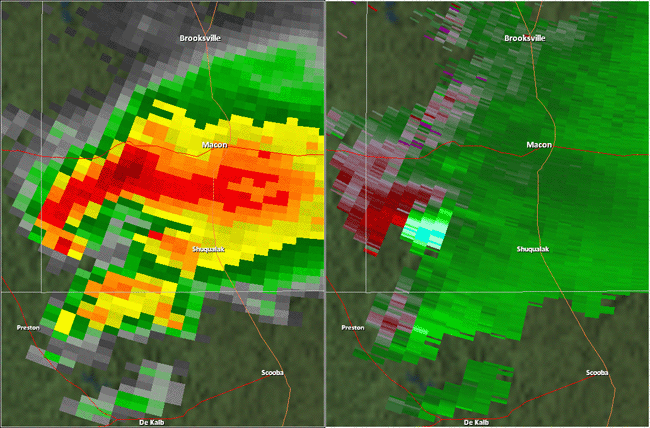
Before I get to the topic about a future event, I feel compelled to talk about one closer to the present. Severe weather season is upon us, though it is off to a slow start. The Southeastern states are arguably past the springtime peak and seem to have gotten off quite light, but we must not forget that it is the months of May and June when so many major tornado disasters have occurred. Jarrell, TX… Moore, OK… the May 2003 outbreak sequence… Greensburg, KS… Parkersburg, IA… those are all F5 or EF5 events except for 2003 (and even it had a tornado that was considered by some to have been underrated as F4). The list goes on, and it does not require an EF5 tornado to do massive, tragic damage. But it is very difficult to forecast severe weather more than a few days in advance, let alone a month or more.

Hurricane season is a different matter, and it is quite possible to make long-range forecasts about the overall activity level of a particular season, especially now that we are merely a month and a half away from the beginning of the Atlantic season. 2010′s hurricane season is not, I believe, going to be anything at all like 2009′s.

The strong El Nino event that gave the Eastern U.S. such a cold and snowy winter (and killed off much Atlantic hurricane activity) is fading fast. The majority of ENSO models predict a return to ENSO-neutral conditions by the June-July-August period (link: PDF).

However, El Nino has left its mark. As is typical following a significant El Nino event, sea surface temperatures in the eastern Atlantic are well above average, and in fact, the anomalies for this year are greater than the anomalies in April of 2005, a year that had record heat across the ocean. In the far eastern part of the ocean, there are areas that are already at 30°C.

Apr. 12, 2010:

Apr. 12, 2005:

Note: All graphics in this post are created by NOAA and are therefore public domain. I have downloaded the graphics current for 04/12/2010 to my server to avoid taking U.S. Government bandwidth. Links to the pages where these graphics were found will not point to the same images at dates in the future.

If this continues and shear decreases as expected, this year may be quite good for long-tracked Cape Verde systems. Indeed, these temperatures are apparently a record in terms of warmth.

The Gulf of Mexico is below average, but this is because of the cold winter. With surface temperatures reaching into the upper 70s and low 80s in the Gulf states for the foreseeable future, and little cloudiness to moderate the effect, it’s likely that this body of water will warm up. Indeed, observing the sea surface temperature anomaly maps for the past few weeks indicates that this warmup is occurring already.

A limiting factor at present may be wind shear, which is above the climatological average:


(Link takes you to the current shear map on NOAA.)

This will continue to be a limiting factor for cyclone development if it persists into the early season. However, as the El Nino fades, shear should decrease. Indeed, the current above-average level of wind shear may only be a temporary event, as overall it has been below average for much of the past several months:


(Link takes you to the current shear graph on NOAA.)

The Bermuda High, an area of high pressure that extends to the western Atlantic, is not yet established. The location of this feature will be important to watch, as it determines whether long-tracked Cape Verde hurricanes tend to strike land—and what landmasses that they strike—or recurve to sea. The farther west it goes, the more likely that such hurricanes will hit a coastline, but too far west and storms tend to be steered south of the United States, as was the case in 2007.

In short: Sea surface temperatures are likely not going to be a problem in 2010. I think the features to watch, here in the pre-season, will be the evolution of ENSO, the location of the Bermuda High, the warmup of the Gulf and far western Atlantic near the Bahamas, and the levels of wind shear as compared to climatology. If the ENSO level decreases to neutral by the peak of the season and shear decreases to the climatological average (and these two factors are very intimately connected, I should note), but sea surface temperatures continue to remain high, I fully expect to see some beasts brewed up and for “Category 5″ to make a reappearance in this basin for the first time since 2007.

Unless the ENSO prediction models are mostly wrong, the Atlantic coasts are not going to get off light this year. It’s impossible yet to determine what areas are likely to be targeted, since we do not know how far west that the Bermuda High will set up, but at present I would go out on a limb and say that somebody is in for a bad year. It’s time to start getting ready.

July 2, 2009

Global Warming Now Messing with El Nino?

Filed under: Science,Weather — PolitiCalypso @ 1:37 pm

Possibly.

Scientists have recently discovered a positive relationship between an alternative type of El Nino, called El Nino Modoki, and Atlantic hurricane activity. The connection had largely slipped under the radar because the scientists in Japan and Korea who knew the most about Modoki did not connect it with Atlantic hurricanes. (It would just figure. This has happened before with respect to ENSO and hurricanes; the ENSO specialists didn’t work with the hurricane specialists, and so that connection wasn’t known for years either.) This type of El Nino involves warming in the central and/or western Pacific rather than the Pacific coast of South America, and it is associated with increased Atlantic hurricane activity and increased landfalls—unlike the traditional El Nino, which tends to suppress activity in this basin.

2004 (of Ivan infamy) was an El Nino Modoki year. 2006 was a traditional El Nino year. 2009… may be a split:

“We spent all last week trying to figure that out,” [Peter] Webster [meteorologist of Georgia Tech] said. ‘It looks like it might be a hybrid,” with warming starting in the east and them moving west, possibly meaning more hurricanes late in the season.

Webster speculates that the Modoki phenomenon may be caused by global warming. Then again, it may not be. I’m rather interested, in fact, in the year 1969, which was an El Nino year for most months but still had a highly active hurricane season, including record Hurricane Camille. General consensus is that we are just now seeing the effects of climate change in our weather, so 1969 may (or may not) be out of the window of opportunity for global warming to have had an effect on El Nino.

As far as that “increased late-season hurricane activity” is concerned, though… that’s about what I figured. I’ve been seeing parallels between the oceanic setup of this year and 2004, and that rather reinforces my belief.

June 16, 2007

Some Things Should Not Be Political

Filed under: Weather — PolitiCalypso @ 2:51 pm

I’ve been following this sorry saga for awhile now, because it’s so utterly typical of bureaucracy, yet thoroughly disgusting. Of all the places where public appearance should be less important than getting it right, the weather agencies should be near the top of the list–yet that seems to be changing. The Weather Service and NOAA seem to be reverting to the pre-1950s era.

In that period, tornadoes were not forecast. The word “tornado” was not used in weather broadcasts, and in fact was banned until 1938. The reasoning for this was that, since the weather agency was unable to forecast tornadoes with much accuracy, false alarms would create panic and make the agency subject to public condemnation. When a military base in Oklahoma, Tinker Air Force Base, began issuing tornado forecasts with a fair amount of accuracy, the Weather Bureau tried to get it to stop, claiming weather forecasting as its own domain. The only result was further public embarrassment, but also, a great advancement in tornado and thunderstorm research, from the necessity of producing a decent forecast.

Here’s what’s been happening a bit more recently.

The Quikscat satellite is a satellite that measures wind patterns, speeds, and directions at the earth’s surface. The satellite often reveals whether a tropical system has developed a closed circulation, which is a requirement for classifying it as a depression rather than an open wave. It also helps reveal wind speeds in tropical storms when they are too far away for the government to send planes to investigate. It’s a highly useful forecasting tool, one that the National Hurricane Center frequently cites in its tropical update products to justify a wind speed. Losing the satellite would result in a 16% decrease in the accuracy of tropical forecasts.

The government has been pushing to decommission the aging satellite without any plans for a replacement. National Hurricane Center director Bill Proenza hasn’t been too happy about this, and he’s made some outspoken comments to the media stating the need for a replacement satellite and his complaints with the appropriation of funds for meteorological research and weather forecasting.

In recent interviews with The Miami Herald and other media, Proenza has strongly criticized leaders of the National Oceanic and Atmospheric Administration for spending millions of dollars on a public-relations campaign when hurricane forecasters deal with budget shortfalls.

Within days, he got a letter from the acting director of the National Weather Service reprimanding Proenza for suggesting that the agency was in any way crippled by the loss of the satellite. The letter offered “constructive advice” on “how to go forward.” In a bureaucracy, this sort of “constructive advice” is usually backed with a thinly veiled threat.

The posturing hasn’t affected the other forecasters at the NHC, though:

Several forecasters and other staffers at the hurricane center have told The Miami Herald that they fully support Proenza, and his comments have earned compliments from many emergency managers and others.

Additionally, get a load of this. Two words in this demonstrate that it isn’t likely to be just typical bureaucracy in action:

Proenza said that on April 13, he was told by Louis Uccellini, a high-ranking weather service official: “You better stop these QuikScat [and other] complaints. I’m warning you. You have NOAA, DOC [the U.S. Department of Commerce] and the White House pissed off.”

The White House, huh? The same White House that organized the “Mission Accomplished” stunt? The same White House that botched the Katrina response? The same White House that stacked the Justice Department with political hacks and fired competent attorneys who didn’t pursue bogus cases of election-related fraud?

So let’s get this straight. After Katrina, the government spends “millions” on a P.R. campaign to make itself look good, while decommissioning a satellite that aids hurricane forecasts. When the director cries foul and raises Cain to the press about it, it gets the higher-ups, including the most notoriously political White House in history, angry at him, angry enough to issue warnings.

Bill Proenza had better hang on tight. It’s a good thing that this is being brought to light now, so that any attempts at firing him would prompt outcry and calls of foul play. He can outlast this.

After director Max Mayfield retired, there was concern over whether his replacement could possibly fill his shoes. But it seems that Proenza is exactly the sort of no-nonsense straight talker that past directors have been. Should the bureaucrats who value their own media reputation more than human life and property get their way, he’ll be replaced with yet another yes-man for a corrupt, sleazy administration. The forecasters and staff who supported him may be shown the door as well.

But the real price will be paid by the coasts.

February 16, 2007

Global Warming Would Drown the Coastal Hurricane Defenses

Filed under: Katrina,Science,Weather — PolitiCalypso @ 6:24 pm

The barrier islands of the Gulf Coast are an important defense against hurricanes. Mostly uninhabited, they are the first landforms that a Gulf Coast hurricane strikes. While they do not weaken the hurricanes (they aren’t large enough), the islands take the brunt of the hurricane’s storm surge, diffusing it somewhat before the eye makes landfall on the mainland. They are also an important defense against tsunami, a real (if little-known) threat. Significant seismic activity has occurred in the Gulf of Mexico fairly recently.

Global warming is predicted to melt part of Greenland and/or West Antarctica, raising sea levels worldwide up to 20 feet (more if all of Greenland and some of West Antarctica melted). This would have horrific consequences on coastal cities around the globe, of course. This blog, however, will focus on one specific area — the United States Gulf Coast. (Ha, doesn’t it always?)

If global warming raised sea levels as predicted, most of low-lying Louisiana — as well as the critical barrier islands — would be underwater. The low-lying swampland of Louisiana, which has been receding for years now, is another natural barrier for the coast, as well as an environmental treasure. It too would be covered in water.

The coastline would lose its natural defenses against hurricanes.

And, as research is indicating, global warming would also intensify the hurricanes themselves.
The EPA produced a series of pictures showing the coastal areas that are most at risk from global warming-induced inundation. Red indicates areas that are less than 1.5 meters above sea level. The images can be clicked on to show a larger view.

Here is an image of Louisiana and Texas:

And here’s one of Mississippi, Alabama, and Florida:

It’s hard to see on these maps, but the barrier islands are the thin trail of red south of the main coastline. They would be underwater.

More disturbingly, from the National Environmental Trust, here is a QuickTime movie of how Biloxi, MS (and its barrier island) would be affected by a rise in sea level. (WARNING for dial-up users: 3 MB file!) I’ve linked to the movie from this graphic I’ve made showing how the coastline would be inundated.

The barrier island protecting the city would no longer exist. Sure, the projection of the land would still exist underwater, and would serve to slightly lessen the impact of a storm surge, but it isn’t at all the same as having a true island above the sea. A dry, projecting landmass stops the flow of water, at least temporarily, and breaks the waves. A former island that has gone underwater obviously doesn’t keep the water from flowing.

Also, as you can clearly see, the city itself would be partially underwater. This includes the glitzy new development that is taking place on this part of the coast in response to Hurricane Katrina — very shortsightedly, I ought to add. Whether this is because of the government of Haley Barbour, who is very likely a global warming skeptic, or because the businesses are aware of the risk but decided to hedge their bets, I do not know.

The Katrina recovery and rebuilding process is not taking global warming into account at all. When the next really bad hurricane strikes, its impact could be compounded by the effects of global warming. The coast will be farther inland due to rising waters, there will be fewer natural barriers, and the hurricane itself is likely to be stronger and wetter than it would be without global warming. And, as unfortunate as it is for me to say this, at this point it’s not enough to simply drive less, replace incandescent light bulbs with fluorescent, cross our fingers, and hope that we’ve stopped the problem.

I absolutely support cutting carbon emissions. If we don’t, the consequences will be even more horrendous than the scientists are daring to predict right now. But we’ve reached a point where it would be nothing short of grossly irresponsible to fail to look into preparation for the potentially disastrous changes that we have brought upon ourselves.

January 8, 2007

The New, Improved, Super-charged El Niño

Filed under: Weather — PolitiCalypso @ 9:42 am

Also, African Rain Moves Westward?

UPDATED, 1/10/2007:
2006 was the warmest year on record, it was reported today, ahead of the previous title holder, 1998. 1998 was influenced heavily by the El Niño that began in 1997. And, sure enough, scientists have concluded that this year’s Niño was, effectively, super-charged by global warming. From the right-leaning Chicago Tribune:

In 1998, record high temperatures were driven by an unusually powerful El Nino current that disrupted weather patterns worldwide. The current El Nino, a periodic warming current that took shape last summer, is far weaker and has had only a moderate effect on global climate, several experts said.

“What we are seeing is much more than El Nino,” said climate analyst Kevin Trenberth at the National Center for Atmospheric Research in Boulder, Colo. “The overall pattern is consistent with our concepts of global warming.”

The original blog entry:
Part 1: El Niño 2006-07: Overachiever or Cheat?

As most people are aware, an El Niño formed in autumn of 2006 and has continued to this date. This event was basically single-handedly responsible for cutting off the 2006 hurricane season at the knees. El Niños do that — the last time we had one, it developed in late autumn of 2004 and ended a two-month streak of damaging hurricanes. And that one wasn’t even very strong. It was weak enough, in fact, that most articles in the popular press that talk about this year’s event don’t even refer to 2004; they say that the last El Niño was in 2002. The one this year is a moderate Niño.

This NOAA site shows the Oceanic Nino Index, an indicator of the temperature departure from the average for various three-month periods, going back to 1950. Positive values indicate El Niño-like conditions and negative values indicate La Niña. The site isn’t updated to reflect the new values, but they have increased past the levels of the 2004 Niño event.

The bottom line, though, is that this year’s event is not even close to the strength of the notorious 1997-1998 event. It is moderate. Mild.

Yet, during the most recent period of warmth for the Eastern United States, heat records were set in numerous eastern cities. The most common date for the old records?

Yep, 1997. There was a winter “heat wave” during the same time period during that year’s Niño as well. (Read more…)

September 6, 2006

Where Are the Hurricanes?

Filed under: Weather — PolitiCalypso @ 9:48 pm

2006 has had a surprisingly slow hurricane season considering that it’s part of the active phase of the Atlantic Multidecadal Oscillation. Tropical Storm Florence is currently spinning in the Atlantic, flirting with the East Coast (but probably won’t make the commitment). Compare this with last year, when we were past the now infamous “K” name, and with 2004, which had already had two Category Four storms and a Category Five (Ivan) brewing.

Every single storm this year has struggled, from the smallest disturbance to the (so far) most powerful system of the year, Category One Hurricane Ernesto. They all experienced dry air and strong shear, which hindered development despite the overall warm sea surface temperatures that I have been documenting since May. Meanwhile, activity in the Pacific Basin has flourished; the eastern part of it is on the “K” name (Kristy). What’s causing this?

Well, the answer appears to be that meteorological boogeyman associated in the public mind with weird weather and general weather-related misfortune: El Niño. Meteorologists are starting to come to agreement that we are entering an El Niño and that it will impact the winter weather this year, as well as the remainder of the hurricane season. What doesn’t it impact?

Hmm…

Well, the weird thing is that Atlantic sea temperatures remain very warm. The Gulf of Mexico is warm enough to support a storm like Hurricane Camille (which had 200 mph winds), and much of the Atlantic can support a major hurricane. Ordinarily, El Niño is accompanied by cooler-than-normal Atlantic temperatures as well as unusual prevailing wind patterns that destroy tropical systems. The winds are there, but not the water temperatures. I wonder if global warming has caused our oceans to remain warmer than normal (whether for El Niño, La Niña, or neutral) for longer than normal. Thus far, this active hurricane cycle, which began in 1995, has had two strong El Niño years: 1997 and 2002. 2004′s hurricane season was cut short by a weak El Niño that developed late in that year, but only 1997 and 2002 experienced a powerful event. In both years, sea temperatures dropped with the onset of the El Niño conditions.

It’s something to think about.

August 31, 2006

Welcome Back, and a Roundup

Filed under: Other — PolitiCalypso @ 8:25 am

Wow, time to dust off, oil, and polish this blog. It’s been awhile. I will have some real blog posts later, and over the weekend, but in the meantime, here’s a roundup of interesting topics.

  • Most importantly of all, I have a new banner graphic.
  • On blog community site Daily Kos, blogger “Bill in Portland Maine” gives us the Hurricane Katrina Hall of Shame, a list of the worst of the worst in quotes from public figures. I am from the Gulf Coast region and have a personal stake in this, but anyone with a heart would do well to read this.
  • The Gulf Coast has lucked out this year, so far. After fears that Ernesto would enter the Gulf of Mexico and intensify to a major hurricane, it took a turn north. I’ll have a blog entry this weekend about the dynamics in play this season, which have thus far kept activity minimal.
  • John Kerry sends out a fundraising e-mail for Ohio gubernatorial candidate Ted Strickland, who is running against Ohio Secretary of State Ken Blackwell. Because he used the true statement that Blackwell abused his office in the 2004 election and prevented legitimate voters from casting their ballots, the media attacks it. Amazing that it’s acceptable political discourse to accuse the opposition party and 60% of the American public of aiding terrorists, but it’s NOT acceptable to call attention to voter suppression.
  • The South’s obesity problem continues to… um, expand.
  • Senators George Felix Allen of Virginia and Conrad Burns of Montana are idiots. With enough people coming out to vote for their opponents–Jim Webb and Jon Tester–they can be removed from office this year. The polls are showing both races neck and neck.

That’s all for now! A preview of features for Friday and the weekend:

  • A blog on the technology of voting systems. Why the systems used in most precincts in the U.S. are horribly insecure

  • A blog on the 2006 Atlantic and Pacific hurricane seasons, with analysis of factors that have so far enhanced or prevented tropical cyclone formation

July 21, 2006

Gulf Goes Nuts

Filed under: Weather — PolitiCalypso @ 3:22 pm
July 19, 2005 July 19, 2006

That, I think, says it all.

This is exactly what worries me about this hurricane season. The entire Gulf can support a Category 5 now, and the East Pacific, despite being slightly cooler than the Gulf, has already produced the powerful Category Four Hurricane Daniel.

The rest of the ocean isn’t quite this warm, but it doesn’t really matter. As an example, Katrina entered the Gulf as a minimal hurricane and became a Category 5 as a direct result of low shear and boiling temperatures without entering any other body of water. Here is what the water temperatures looked like before Katrina’s entrance (using the same scale as the previous pictures):

The Gulf is clearly well on its way to this level.

The Gulf Coast, as battered as the infrastructure may be, must do something in preparation, and soon. There are people who still need housing. There are communities still struggling after Katrina. Parts of New Orleans remain a war zone.

Unless this season is extremely unusual, some spot on the Gulf Coast is likely to take a major hurricane strike in 60 days or less.

Please. Nobody wants to see yet another catastrophe.

Older Posts »

Powered by WordPress. This theme is a heavy modification of the WordPress Classic theme planned to match the layout of ErinThead.com. Because of its very specific and personalized nature, it is not available for public download. Content copyright ©2005-2009.