April 28, 2011

Some Thoughts on the Super Outbreak of the South

Filed under: Other — PolitiCalypso @ 9:14 pm

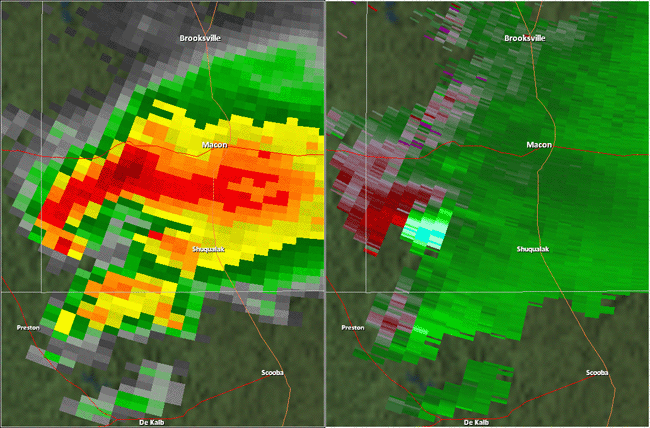
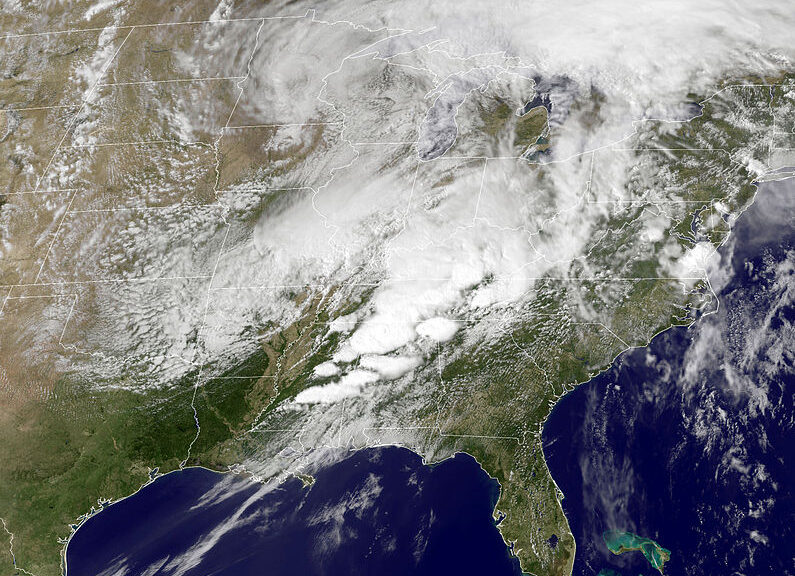
I am in a rather turbulent state of simultaneous awe, amazement, appalled shock, and horror at what took place in the South yesterday, and I do not have the slightest compunction in calling it the Super Outbreak of the South, as the title indicates.  As a meteorologist-in-training, I can’t deny the amazement and almost religious awe that I feel at the sheer force of nature.  (In fact, I’m reminded very much of Job 37.)  By themselves, these phenomena are utterly spectacular.  We can read about the Great Red Spot on Jupiter, a storm which dwarfs anything on Earth, and feel nothing but awe, because there are no living things there.  I was watching WCBI News out of Columbus, MS on Wednesday, and I doubt I will ever forget the moment that the meteorologist switched to the Tuscaloosa SkyCam and caught the monstrous, violent tornado dead center as it entered that city.  But that, of course, leads in to the dark side of these events.  However awe-inspiring they are in and of themselves, it is when they enter human areas that they become tragic.

Some thoughts, now, on that human tragedy.

Funding the National Weather Service

If there are still any Congressional Representatives out there who want to decimate the National Weather Service or NOAA’s weather-related operations, they ought to be ashamed of themselves.  That goes double for those representing states that were impacted in this event (or in any of the events this month).  As bad as the casualty count is, it would have been far worse 100 years ago when the Weather Service (Weather Bureau at that time) was rudimentary and people depended entirely on whatever local “private sector” warnings were available to them, typically based on whether a tornado or bad storm system was already known to have occurred somewhere upstream.

Don’t get me wrong; the private sector plays a critical role here.  I will guess that most people outside the meteorological community received their information yesterday from private sector sources such as radio and TV broadcasts.  The private sector is the link between the government and the public, and it is a crucial link.  However, the private sector simply cannot do everything that NOAA does in the background.  Yesterday’s event was, in effect, a “perfect” forecast, in forecasting terms.  It was as good as we could possibly do.  And what went into that forecast to make it so good?  Here’s a short list:  satellite data, real-time radar data, radiosonde observations from dozens of sites, weather station observations from dozens of sites across the U.S., numerical weather model predictions run on supercomputers in Maryland, and human forecasters combing through these data at numerous facilities.  For this type of work to be done by private companies, there would either be a single entity owning all the data in a monopoly, or there would be broken, fragmented sets of data that some companies had access to (having gathered it) and others did not, and the weather just doesn’t work in a discrete way like that.  The atmosphere is a fluid.

The government has to run all this in the background for it to work well.  That does not mean that the private sector, even outside of broadcast media, cannot exist. If I wanted to get some NOAA computer model data, repackage it through some graphical post-processing of my own, add commentary of my own, and sell it for a profit, I could do just that.  If I wanted to download a copy of the government- and academia-created WRF model, run it on a machine of my own with my own configuration, and sell that for a profit, I could.  Many sources have done this with public data.  AccuWeather Professional comes to mind, but there are others.  The very fact that this is all public data means that private sources can do other things with it and sell it for a profit entirely legally.  This would not be possible if the backend were all privately owned.  It is in the interest of human life and free enterprise for the data to remain public.

I sincerely hope that this outbreak of severe weather signals the end (at least for several years) of this short-sighted call to go after NOAA in the name of balancing the budget.  There are plenty of government programs that are nonessential that can be cut.  This sector is not one of them.  Wednesday’s tornado outbreak probably would have resulted in ten times as many fatalities 100 years ago.  Anyone who wants to cut funding to the NWS or to any of the branches of NOAA that have operations that go into making a weather forecast, or researching the weather, needs to read a book about the history of weather forecasting in the U.S. and then tell me again what they think.  I have an inkling that, over the past year or so, my political views became rather less liberal than they used to be, as I have become more cynical about the abuse of welfare, the inadvisability of government to support one point of view (by funding nonprofits) over another with respect to solutions to social problems, and the ill effects of federal bureaucracies in some sectors such as education, but this is a case where I firmly come down on the side of government funding for a service, and I do not foresee that changing.

Storm Shelters and the Southeast

I have harped for years on the disasters that will befall the Southeast if something were not done about the lack of proper shelter in this region.  The Plains states and (to a lesser extent) the Midwest learned from their own tragedies, such as the Woodward tornado, the Tri-State Tornado, and the Super Outbreak of 1974, that people simply are not safe above ground in EF4 to EF5 events even in well-built houses.  Those who live in trailers are not safe even in EF2 tornadoes.  There are some communities that have storm shelters; they are to be commended for this.  Tornado sirens are also more common in the Southeast than they used to be; this is also a good thing.  Perhaps there is some recognition that Tornado Alley is far larger than just the Plains, and that the “alley” for long-track violent (4 and 5) tornadoes is, in fact, the Deep South, by a long shot.

And I suspect that the tornado responsible for a plurality of Wednesday’s deaths will be the long-tracked violent (probably EF5, definitely EF4+) tornado that hit Tuscaloosa and Birmingham, Alabama.  My local TV meteorologist, Rob Smith, reported that this monster had a velocity couplet on radar of 290 mph over Tuscaloosa.  As far as I am aware, there is no well-established vertical profile of tornadic winds, unlike the winds in hurricanes, where this information is well-known enough that surface winds can be extrapolated reasonably accurately from flight-level winds.  However, velocity couplets of that intensity are not common, to say the least.  Furthermore, Roger Edwards, a meteorologist at the Storm Prediction Center (reputedly where the best forecasters in the U.S. work), said that the swirling horizontal mesovortices that snaked around this thing had never been seen by him except in violent tornadoes.  What do you do when a beast like that is coming at you?

Get out of town?  I did that yesterday, taking only my cat, my computer, and a couple of sentimental items, when it looked like a confirmed large tornado with a debris ball was going to hit my house or my town.  (It shifted its path south.)  But then, I know something about the structure of storms, I knew how fast it was going and could judge how fast I needed to drive to get completely clear of any path shifts it might make, I knew what was in front of me (nothing for at least 50 miles), I knew what was coming the way I was driving (again, nothing), and I live in a rural area where this was a reasonable option.  It is not a reasonable option for people who live in a city and will easily lead to traffic snarls.  I hope this did not happen yesterday.  Being in a car in a violent tornado, or any tornado, is worse than being in a building by far.

Head to an interior room on the first floor?  Staying above ground is not a death sentence in an EF4 or EF5, but survival is a matter of chance and Providence if this is what you do.  Go to a basement?  A copyrighted image on CNN depicted homes in Pleasant Grove, AL (outside Birmingham) that had the basements exposed after the tornado.  This has happened before in the Parkersburg, IA EF5 tornado.  Having an underground shelter directly below the building probably isn’t sufficient either for this exact reason.  The best design is probably the “fallout shelter” type of storm cellar, with the main room somewhat removed horizontally from the entrance to the cellar.

The South needs more of these, and yet I am opposed to making it mandatory under the law.  I am even opposed to it if funding were provided in the form of vouchers.  I don’t think it’s the responsibility of the government to make people take care of themselves.  However, I do think that there should be some financial “reward” for getting a shelter, perhaps in the form of a tax credit or even a tax rebate. Mississippi’s EMA had a program of this general type not long ago, but evidently there was a lack of public awareness, because I don’t know anyone who took advantage of it.

I was horrified in 2008 after the Super Tuesday outbreak, which killed 57 people, mostly in the South.  I had no idea that I would live to see something very similar to a repeat of the Super Outbreak of 1974 in my region, and definitely not the casualty count of that terrible event.  Yesterday’s event was well-forecast, and information was disseminated spectacularly well over the news (live footage of the Alabama beast) and the Internet.  There is plenty that we don’t know about tornadoes and thunderstorms, but these unknowns are not responsible for the tragic outcome of yesterday’s event.  Public awareness and information dissemination may be responsible for some of the fatalities, certainly, especially those in small towns where broadband Internet access may not be available and the tornadoes do not have live TV coverage.  However, these are isolated cases.  The problem was the magnitude of the tornadoes and the insufficiency of shelter options.  Unfortunately, the South will continue to see tragic death tolls as long as proper shelter is not available.

The EF Scale and Urban Tornadoes

Violent tornadoes have struck the outskirts of cities numerous times, such as the “Moore tornado” of 1999 that hit near Oklahoma City.  Tornadoes of various intensities have also struck the downtown areas of cities.  However, I am not aware of an EF4 or EF5 tornado (or their counterparts on the Fujita Scale) that struck the downtown area of a city of 90,000 people or more at the violent intensity. I don’t know what the Tuscaloosa-Birmingham tornado will ultimately be rated.  I have seen enough pictures that I have my own opinion, but I’m not on the survey team, and as this event is either very rare or is without precedent, they will certainly conduct their survey with the utmost care and professionalism.  However, the possibility of a “5″-rated tornado striking a densely populated urban area opens up an interesting question about the EF scale.

The scale is an improvement over the Fujita Scale in that it offers damage criteria for a variety of buildings.  However, the most well-known criterion for distinguishing between an EF4 and an EF5 is the one that relates to “well-constructed frame houses.”  If the house is blown down, it is EF4.  If it’s blown away leaving a clean slab, it’s EF5.  But how can there be a clean slab in the middle of an urban center?  Not to be callous here, but it will be much easier to get empty foundations in a subdivision a few acres across, surrounded by other subdivisions (or rural land) and lacking the structural congestion of urban environments.  I just find it hard to imagine how this type of damage could possibly occur in a city.  There will be much more debris in these situations than in a suburban, small-town, or rural violent tornado, and I would make a guess that it would be much harder to get clean slabs in light of that.  The damage pictures out of downtown Tuscaloosa seem to bear this out.  There are mounds of debris, some identifiable, some not.  There are piles of bricks from buildings that were certainly reduced to their foundations, but I haven’t seen clean slabs in McFarland Boulevard or any of the other downtown areas there, nor do I expect to, given the amount of construction that had been there.  Will the EF scale work for violent tornadoes in highly populated, highly developed urban environments?  We’ll have to see.

May 12, 2009

Crist Is Part of the Solution

Filed under: Politics — PolitiCalypso @ 2:57 pm

Though I’m not in Florida, I’m pleased that Gov. Charlie Crist is running for the Senate seat being vacated by Mel Martinez. This is a fine example of the kind of politics that I think will be necessary both to uplift the South from right-wing reactionary rule and to produce a viable and non-frightening opposition party for whenever the Democrats mess up.

I’ve written before about the need for moderate Southerners to run for political office in Republican primaries. Crist is already a Republican, of course, and a rather popular one at that; the question was about whether he would run for this office. He’s also pretty much indisputably a moderate (proving my point in the past two articles that it is possible for moderates to be well-liked in the South). I’m glad that he’s running. If he is the nominee, as is (I hope) likely, it should be an interesting race to watch, as there is not likely to be much difference between many of his views and the views of his Democratic opponent. Considering that, he may try to shore up the right flank in the general election. It wouldn’t surprise me either way. But as we know all too well, campaign rhetoric often doesn’t mean a whole lot.

As could perhaps be expected, the mainstream bloggers have this all wrong. Nate Silver of fivethirtyeight.com, which I linked to, is the only prominent person with a reasonable opinion on it. The luminaries at flagship blog Daily Kos are gleefully contemplating the likelihood of a primary between Crist and hard-right Club for Growth ideologue Marco Rubio. The belief is that Rubio is dead in the water as a general election candidate, as Pat Toomey now is in Pennsylvania, and that a Rubio nomination should be advocated and promoted. Wrong. (Read more…)

April 28, 2009

Wherein I Reiterate Something I’ve Said

Filed under: Politics — PolitiCalypso @ 6:16 pm

I cannot say I’m too happy right now about Arlen Specter’s switch to the Democratic Party. Sure, I think it’s hilarious, but underneath that, there are implications that trouble me. Although I now consider myself an unaffiliated independent voter, my views are certainly to the left of the Southern majority, so I generally end up voting for Democrats at the national level and I take an interest in what direction the party is moving. As far as that goes, I really don’t mind that Specter is a moderate on certain issues, but I am troubled by his (current) refusal to switch his support in favor of the Employee Free Choice Act, a bill that would make it easier for employees to form a union and would give them the right to choose how they wanted to do that. I’ve come to believe that widespread unionization was a major driving force behind the boom period of the 1950s, in which household wealth (real wealth, not debt) skyrocketed and the country’s GDP grew. Unionization levels the playing field significantly in the private sector, taking away the near-absolute power that managers would otherwise have to determine salaries, benefits, and working conditions. EFCA is a good bill and it needs to become law.

Therefore it is my hope that, despite his statements that he will not switch to supporting this bill, Specter does come around. If this happens, I don’t think it would be a self-centered political move like this party switch indisputably is. Specter has a very long track record of supporting labor, which is why the unions in Pennsylvania have tended to support his election campaigns. If anything, his statement that he would oppose EFCA was a self-centered political move, a failed Hail Mary pass to try to get him through the Republican primary next year. He may very well decide to support it after all if that is where his true convictions (such as they are) lie. After all, he went on record as saying that he would not switch party affiliation, and look what happened.

In any case, whether Specter switches back on EFCA remains to be seen. I’d tentatively bet on it, but I think it would take time for him to announce that. There are other issues relating to this man’s switch, though, that are actually far more troublesome. (Read more…)

Powered by WordPress. This theme is a heavy modification of the WordPress Classic theme planned to match the layout of ErinThead.com. Because of its very specific and personalized nature, it is not available for public download. Content copyright ©2005-2009.