April 28, 2011

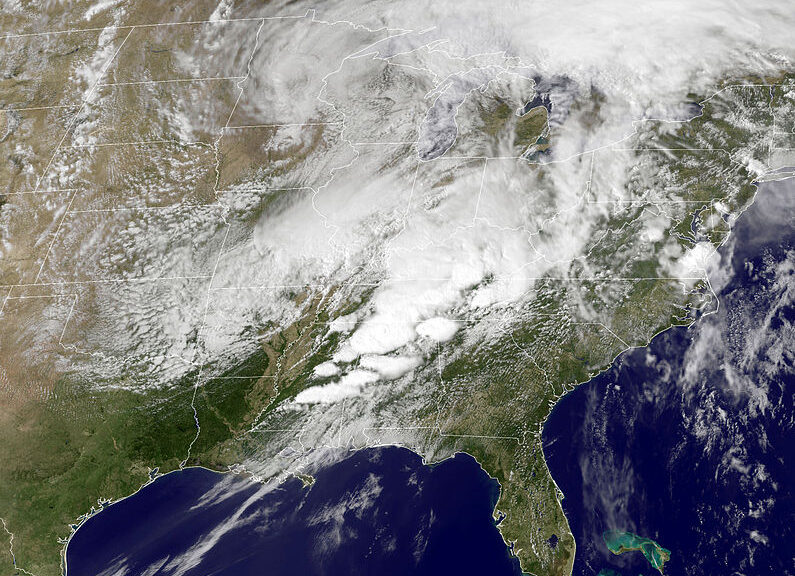
Some Thoughts on the Super Outbreak of the South

Filed under: Other — PolitiCalypso @ 9:14 pm

I am in a rather turbulent state of simultaneous awe, amazement, appalled shock, and horror at what took place in the South yesterday, and I do not have the slightest compunction in calling it the Super Outbreak of the South, as the title indicates.  As a meteorologist-in-training, I can’t deny the amazement and almost religious awe that I feel at the sheer force of nature.  (In fact, I’m reminded very much of Job 37.)  By themselves, these phenomena are utterly spectacular.  We can read about the Great Red Spot on Jupiter, a storm which dwarfs anything on Earth, and feel nothing but awe, because there are no living things there.  I was watching WCBI News out of Columbus, MS on Wednesday, and I doubt I will ever forget the moment that the meteorologist switched to the Tuscaloosa SkyCam and caught the monstrous, violent tornado dead center as it entered that city.  But that, of course, leads in to the dark side of these events.  However awe-inspiring they are in and of themselves, it is when they enter human areas that they become tragic.

Some thoughts, now, on that human tragedy.

Funding the National Weather Service

If there are still any Congressional Representatives out there who want to decimate the National Weather Service or NOAA’s weather-related operations, they ought to be ashamed of themselves.  That goes double for those representing states that were impacted in this event (or in any of the events this month).  As bad as the casualty count is, it would have been far worse 100 years ago when the Weather Service (Weather Bureau at that time) was rudimentary and people depended entirely on whatever local “private sector” warnings were available to them, typically based on whether a tornado or bad storm system was already known to have occurred somewhere upstream.

Don’t get me wrong; the private sector plays a critical role here.  I will guess that most people outside the meteorological community received their information yesterday from private sector sources such as radio and TV broadcasts.  The private sector is the link between the government and the public, and it is a crucial link.  However, the private sector simply cannot do everything that NOAA does in the background.  Yesterday’s event was, in effect, a “perfect” forecast, in forecasting terms.  It was as good as we could possibly do.  And what went into that forecast to make it so good?  Here’s a short list:  satellite data, real-time radar data, radiosonde observations from dozens of sites, weather station observations from dozens of sites across the U.S., numerical weather model predictions run on supercomputers in Maryland, and human forecasters combing through these data at numerous facilities.  For this type of work to be done by private companies, there would either be a single entity owning all the data in a monopoly, or there would be broken, fragmented sets of data that some companies had access to (having gathered it) and others did not, and the weather just doesn’t work in a discrete way like that.  The atmosphere is a fluid.

The government has to run all this in the background for it to work well.  That does not mean that the private sector, even outside of broadcast media, cannot exist. If I wanted to get some NOAA computer model data, repackage it through some graphical post-processing of my own, add commentary of my own, and sell it for a profit, I could do just that.  If I wanted to download a copy of the government- and academia-created WRF model, run it on a machine of my own with my own configuration, and sell that for a profit, I could.  Many sources have done this with public data.  AccuWeather Professional comes to mind, but there are others.  The very fact that this is all public data means that private sources can do other things with it and sell it for a profit entirely legally.  This would not be possible if the backend were all privately owned.  It is in the interest of human life and free enterprise for the data to remain public.

I sincerely hope that this outbreak of severe weather signals the end (at least for several years) of this short-sighted call to go after NOAA in the name of balancing the budget.  There are plenty of government programs that are nonessential that can be cut.  This sector is not one of them.  Wednesday’s tornado outbreak probably would have resulted in ten times as many fatalities 100 years ago.  Anyone who wants to cut funding to the NWS or to any of the branches of NOAA that have operations that go into making a weather forecast, or researching the weather, needs to read a book about the history of weather forecasting in the U.S. and then tell me again what they think.  I have an inkling that, over the past year or so, my political views became rather less liberal than they used to be, as I have become more cynical about the abuse of welfare, the inadvisability of government to support one point of view (by funding nonprofits) over another with respect to solutions to social problems, and the ill effects of federal bureaucracies in some sectors such as education, but this is a case where I firmly come down on the side of government funding for a service, and I do not foresee that changing.

Storm Shelters and the Southeast

I have harped for years on the disasters that will befall the Southeast if something were not done about the lack of proper shelter in this region.  The Plains states and (to a lesser extent) the Midwest learned from their own tragedies, such as the Woodward tornado, the Tri-State Tornado, and the Super Outbreak of 1974, that people simply are not safe above ground in EF4 to EF5 events even in well-built houses.  Those who live in trailers are not safe even in EF2 tornadoes.  There are some communities that have storm shelters; they are to be commended for this.  Tornado sirens are also more common in the Southeast than they used to be; this is also a good thing.  Perhaps there is some recognition that Tornado Alley is far larger than just the Plains, and that the “alley” for long-track violent (4 and 5) tornadoes is, in fact, the Deep South, by a long shot.

And I suspect that the tornado responsible for a plurality of Wednesday’s deaths will be the long-tracked violent (probably EF5, definitely EF4+) tornado that hit Tuscaloosa and Birmingham, Alabama.  My local TV meteorologist, Rob Smith, reported that this monster had a velocity couplet on radar of 290 mph over Tuscaloosa.  As far as I am aware, there is no well-established vertical profile of tornadic winds, unlike the winds in hurricanes, where this information is well-known enough that surface winds can be extrapolated reasonably accurately from flight-level winds.  However, velocity couplets of that intensity are not common, to say the least.  Furthermore, Roger Edwards, a meteorologist at the Storm Prediction Center (reputedly where the best forecasters in the U.S. work), said that the swirling horizontal mesovortices that snaked around this thing had never been seen by him except in violent tornadoes.  What do you do when a beast like that is coming at you?

Get out of town?  I did that yesterday, taking only my cat, my computer, and a couple of sentimental items, when it looked like a confirmed large tornado with a debris ball was going to hit my house or my town.  (It shifted its path south.)  But then, I know something about the structure of storms, I knew how fast it was going and could judge how fast I needed to drive to get completely clear of any path shifts it might make, I knew what was in front of me (nothing for at least 50 miles), I knew what was coming the way I was driving (again, nothing), and I live in a rural area where this was a reasonable option.  It is not a reasonable option for people who live in a city and will easily lead to traffic snarls.  I hope this did not happen yesterday.  Being in a car in a violent tornado, or any tornado, is worse than being in a building by far.

Head to an interior room on the first floor?  Staying above ground is not a death sentence in an EF4 or EF5, but survival is a matter of chance and Providence if this is what you do.  Go to a basement?  A copyrighted image on CNN depicted homes in Pleasant Grove, AL (outside Birmingham) that had the basements exposed after the tornado.  This has happened before in the Parkersburg, IA EF5 tornado.  Having an underground shelter directly below the building probably isn’t sufficient either for this exact reason.  The best design is probably the “fallout shelter” type of storm cellar, with the main room somewhat removed horizontally from the entrance to the cellar.

The South needs more of these, and yet I am opposed to making it mandatory under the law.  I am even opposed to it if funding were provided in the form of vouchers.  I don’t think it’s the responsibility of the government to make people take care of themselves.  However, I do think that there should be some financial “reward” for getting a shelter, perhaps in the form of a tax credit or even a tax rebate. Mississippi’s EMA had a program of this general type not long ago, but evidently there was a lack of public awareness, because I don’t know anyone who took advantage of it.

I was horrified in 2008 after the Super Tuesday outbreak, which killed 57 people, mostly in the South.  I had no idea that I would live to see something very similar to a repeat of the Super Outbreak of 1974 in my region, and definitely not the casualty count of that terrible event.  Yesterday’s event was well-forecast, and information was disseminated spectacularly well over the news (live footage of the Alabama beast) and the Internet.  There is plenty that we don’t know about tornadoes and thunderstorms, but these unknowns are not responsible for the tragic outcome of yesterday’s event.  Public awareness and information dissemination may be responsible for some of the fatalities, certainly, especially those in small towns where broadband Internet access may not be available and the tornadoes do not have live TV coverage.  However, these are isolated cases.  The problem was the magnitude of the tornadoes and the insufficiency of shelter options.  Unfortunately, the South will continue to see tragic death tolls as long as proper shelter is not available.

The EF Scale and Urban Tornadoes

Violent tornadoes have struck the outskirts of cities numerous times, such as the “Moore tornado” of 1999 that hit near Oklahoma City.  Tornadoes of various intensities have also struck the downtown areas of cities.  However, I am not aware of an EF4 or EF5 tornado (or their counterparts on the Fujita Scale) that struck the downtown area of a city of 90,000 people or more at the violent intensity. I don’t know what the Tuscaloosa-Birmingham tornado will ultimately be rated.  I have seen enough pictures that I have my own opinion, but I’m not on the survey team, and as this event is either very rare or is without precedent, they will certainly conduct their survey with the utmost care and professionalism.  However, the possibility of a “5″-rated tornado striking a densely populated urban area opens up an interesting question about the EF scale.

The scale is an improvement over the Fujita Scale in that it offers damage criteria for a variety of buildings.  However, the most well-known criterion for distinguishing between an EF4 and an EF5 is the one that relates to “well-constructed frame houses.”  If the house is blown down, it is EF4.  If it’s blown away leaving a clean slab, it’s EF5.  But how can there be a clean slab in the middle of an urban center?  Not to be callous here, but it will be much easier to get empty foundations in a subdivision a few acres across, surrounded by other subdivisions (or rural land) and lacking the structural congestion of urban environments.  I just find it hard to imagine how this type of damage could possibly occur in a city.  There will be much more debris in these situations than in a suburban, small-town, or rural violent tornado, and I would make a guess that it would be much harder to get clean slabs in light of that.  The damage pictures out of downtown Tuscaloosa seem to bear this out.  There are mounds of debris, some identifiable, some not.  There are piles of bricks from buildings that were certainly reduced to their foundations, but I haven’t seen clean slabs in McFarland Boulevard or any of the other downtown areas there, nor do I expect to, given the amount of construction that had been there.  Will the EF scale work for violent tornadoes in highly populated, highly developed urban environments?  We’ll have to see.

October 7, 2009

An Opt-Out Public Option Lets Red States SENTENCE THEIR PEOPLE TO DEATH by Popular Vote

Filed under: Politics — PolitiCalypso @ 11:11 pm

As we approach the endgame of the health care reform debate in Congress, an idea has been floated recently that might be the worst one I have yet encountered.  Yes, in my book it tops out mandates without a public option, taxing health care policies, triggers, and co-operative plans.  The idea is to have a strong national public option but to allow state governments individually to opt out of allowing their residents to make use of it.  This idea has picked up steam in the “progressive netroots community” (bloggers), with a surge in support on flagship blog Daily Kos, among others.

It is a truly horrible idea, though, and it just goes to show that bad ideas do not only come from Blue Dog Democrats or Tea Party Republicans.  Self-described “progressives” can have them too.

“Progressive” Activists Betray the Legacy of the Civil War:  A United U. S. A.

This is far from the first time that “progressives” have advocated Balkanization of the United States and the breakdown of the federal government in favor of a loose alliance such as that proposed by the Articles of Confederation.  In the lead-up to the American Civil War, many Northern progressives said “Let the South go” rather than fighting militarily to bring seceded states back into the U.S.  These 1860s-era progressives did not really care about the human rights issue of slavery.  Many of them believed that slavery would collapse under its own weight and the South might voluntarily choose to return.  Obviously, history did not take this path, so we do not know how it would have turned out if President Lincoln had followed this advice and war had not broken out.  However, we do know one thing:  African Americans would have remained enslaved for far longer than they were.  Not just living under the iron heel of Jim Crow laws, but actually enslaved.  We also know that, though some aspects of Reconstruction were extremely broken, when that process ended by the “corrupt bargain” of the 1876 election, Jim Crow laws were immediately forced into effect.  That’s what happened when they “let the South go.”  Human and civil rights in the South were eroded.

The legacy of the Civil War was not just the abolition of slavery and the enshrining in the Constitution of voting rights to people (men, at the time) of any race.  Another part of the legacy was the principle that there are certain things individual states cannot do.  The War settled the question of secession and nullification.  If states are part of the U.S., they abide by the laws of the U.S. and cannot deny their residents the protections of the Constitution, the United States Code, and federal programs.

Of course, if a health care reform bill is signed and it allows states to opt out of a robust national public option, this would blow a hole right through that ideal.  Legally, of course; there is nothing in the Constitution that says Washington cannot enact laws with an opt-out clause for states.  But the very existence of this hypothetical opt-out would go against one of the legacies of the Civil War, just as surely as it would go against the legacy of abolition if the U.S. somehow overturned the Thirteenth Amendment through legal means.  For progressives to be advocating this idea is a monumental betrayal.

Death by Popular Vote

It’s not just a betrayal of E Pluribus Unum, either.  This idea is a betrayal of every person in a Republican-dominated state who is in favor of a public option.  It is saying to us that we don’t count.  Here is a direct quote from a popular Daily Kos diary in support of this idea:

(…) I really love the idea of an opt-out public option.

Not because it’s the best idea by any means. A robust single-payer plan would be the best idea. Not because tens of thousands of real Americans won’t die and go bankrupt in states with morally bankrupt legislators. They will.

Our lives are meaningless, then, to the “progressive netroots community” except as political pawns.  The message absolutely could not be clearer.

I know what the residents of my state would probably vote for.  I certainly know what my governor and Legislature would do.  And while I would indeed apportion blame to them if Mississippi denied its residents access to a national public option, I would apportion a great deal more to the ivory tower blue coast “progressives,” and any members of Congress who voted for such a thing, for making it possible and legal for them to do it.

People in the South and other Red areas will die because of this, if it passes, whereas they would not die in Blue states.  This means that a state’s populace would be allowed to sentence people to death, permanent indigence, or bankruptcy by a popular fiat.  Have we sunk so far?  There was massive outrage—MASSIVE, I say—about the idea behind California’s Proposition 8 and the fact that 50% + 1 could deny court-established civil rights to people.  Where did the outrage go?  Or was it only ever present because LGBT people are generally a liberal-oriented group and California was a blue state?

I am a former Democratic Senate staffer, actually, but I would NOT forget that it was the progressive community and Democrats in Congress who allowed townhallers, teabaggers, and insura-cons in my state to sentence people like me to death or bankruptcy.  Want my vote in the future?  Want the votes of any left-of-center Southerners in the future?  Too bad, suckers.  If this idea ends up passing, we will remember exactly who it was that sold us down the river.  We would expect no less from our troglodyte state governments, whom we do not vote for anyway, but we depend on Washington to keep their harmful ideologies somewhat in check.  This idea won’t turn the South blue.  All it will do is royally tick off Southern Democrats and liberal-inclined people.  (Yes, I am a civil libertarian oriented liberal, not that cowardly weasel-word “progressive.”)  It will send the message loud and clear that our lives, health, and finances do not matter because of where we live, that we are not worth fighting for, that we have no inherent value, but are only useful as a body count to make a political point.

I’ve suspected this for some time about the “progressive” community’s real opinion of Hurricane Katrina’s victims, and this idea does not do one thing to dispel this suspicion.  It only reinforces it, in fact.  Apparently, if you live outside of a Blue area, your only value to this part of the “netroots community” is as a part of a body count that they can use to advance a political agenda.  Even if it’s an agenda that you otherwise would agree with, nobody wants their entire worth to be dependent upon their being dead.

In truth, this whole scheme gives the impression of being revenge politics. If you are at all familiar with the left-wing blogosphere, you’ll know that there is a huge amount of resentment over the fact that the South gets more money from the federal government than it pays in. The people who hold this resentment ignore that the entire purpose of social programs and such is to assist the poor, and the South is the poorest region in the country. To them, no one in the South deserves anything because a majority of Southern voters would vote against their having it. They are no different from anti-tax Republicans in that they only want to see “their” tax money go to projects and places that they personally like, and they have a massive grudge against the Southeast. This opt-out idea looks very much to me like they simply love the idea of “getting back at the South” for the tax money that it “stole” from them.

Passing a law with this in it would also send the message that health care is not a fundamental human or civil right in the United States.  If it were either, it would be the responsibility of the federal government to require every state to offer the same health care exchange across the borders.  With the exception of the death penalty, the federal government does not defer to states in the arena of human or civil rights (and it is truly a major problem with the DP that the same crime can get a different sentence not based on the judge and jury, but based on where it was committed).  By letting states opt out, this continues to send the message that health care is a privilege rather than a right.  This is not the message that we want to send!  That is the opposition’s message.

It will not turn the teabag crew in favor of the Democratic Party.  Their people are dying at the hands of insurance gangsters, too; it doesn’t seem to penetrate their skulls.  If anything, all it will do is cement their ideology.  “We don’t have socialism in this state!”

Denying—or letting governors and legislatures deny—people the right to use a social program is not going to turn anyone in favor of that program.  The only thing that will is to deploy it and let people see through experience, either their own or that of people they know, that it is not such a bad thing.  Every parent knows that sometimes they must force a stubborn child to do something, even if the child stamps his foot and DOESN’T WANT TO, because it is good for the child and the child will be grateful for it in the end.

May 12, 2009

Crist Is Part of the Solution

Filed under: Politics — PolitiCalypso @ 2:57 pm

Though I’m not in Florida, I’m pleased that Gov. Charlie Crist is running for the Senate seat being vacated by Mel Martinez. This is a fine example of the kind of politics that I think will be necessary both to uplift the South from right-wing reactionary rule and to produce a viable and non-frightening opposition party for whenever the Democrats mess up.

I’ve written before about the need for moderate Southerners to run for political office in Republican primaries. Crist is already a Republican, of course, and a rather popular one at that; the question was about whether he would run for this office. He’s also pretty much indisputably a moderate (proving my point in the past two articles that it is possible for moderates to be well-liked in the South). I’m glad that he’s running. If he is the nominee, as is (I hope) likely, it should be an interesting race to watch, as there is not likely to be much difference between many of his views and the views of his Democratic opponent. Considering that, he may try to shore up the right flank in the general election. It wouldn’t surprise me either way. But as we know all too well, campaign rhetoric often doesn’t mean a whole lot.

As could perhaps be expected, the mainstream bloggers have this all wrong. Nate Silver of fivethirtyeight.com, which I linked to, is the only prominent person with a reasonable opinion on it. The luminaries at flagship blog Daily Kos are gleefully contemplating the likelihood of a primary between Crist and hard-right Club for Growth ideologue Marco Rubio. The belief is that Rubio is dead in the water as a general election candidate, as Pat Toomey now is in Pennsylvania, and that a Rubio nomination should be advocated and promoted. Wrong. (Read more…)

April 28, 2009

Wherein I Reiterate Something I’ve Said

Filed under: Politics — PolitiCalypso @ 6:16 pm

I cannot say I’m too happy right now about Arlen Specter’s switch to the Democratic Party. Sure, I think it’s hilarious, but underneath that, there are implications that trouble me. Although I now consider myself an unaffiliated independent voter, my views are certainly to the left of the Southern majority, so I generally end up voting for Democrats at the national level and I take an interest in what direction the party is moving. As far as that goes, I really don’t mind that Specter is a moderate on certain issues, but I am troubled by his (current) refusal to switch his support in favor of the Employee Free Choice Act, a bill that would make it easier for employees to form a union and would give them the right to choose how they wanted to do that. I’ve come to believe that widespread unionization was a major driving force behind the boom period of the 1950s, in which household wealth (real wealth, not debt) skyrocketed and the country’s GDP grew. Unionization levels the playing field significantly in the private sector, taking away the near-absolute power that managers would otherwise have to determine salaries, benefits, and working conditions. EFCA is a good bill and it needs to become law.

Therefore it is my hope that, despite his statements that he will not switch to supporting this bill, Specter does come around. If this happens, I don’t think it would be a self-centered political move like this party switch indisputably is. Specter has a very long track record of supporting labor, which is why the unions in Pennsylvania have tended to support his election campaigns. If anything, his statement that he would oppose EFCA was a self-centered political move, a failed Hail Mary pass to try to get him through the Republican primary next year. He may very well decide to support it after all if that is where his true convictions (such as they are) lie. After all, he went on record as saying that he would not switch party affiliation, and look what happened.

In any case, whether Specter switches back on EFCA remains to be seen. I’d tentatively bet on it, but I think it would take time for him to announce that. There are other issues relating to this man’s switch, though, that are actually far more troublesome. (Read more…)

February 24, 2009

Why Southern Moderates Should Run as GOP

Filed under: Politics — PolitiCalypso @ 7:01 pm

I’ve never been able to understand why everyone to the left of Pat Robertson chooses to run for office on the Democratic ticket in the Southeast region. It’s inadvisable in this region (except for those positions that are specifically for Democratic districts, like the absurdly gerrymandered Congress) as a personal electoral strategy, because—again, with that noted exception—the Southeast in general votes Republican by default. And it’s foolish as a long-term strategy for anyone who is troubled by the dominance of Religious Right theocratic politics in this region.

Let’s go ahead and get a few things out of the way. First, since this is unfortunately usually associated with Southern politics in some way, the recommendations I offer are not specific to any given race of people—but rather, to moderates of any ancestry. Secondly, I am not talking about voting. I’m talking about those with political ambitions. I’m talking about running for office. Third, I am not necessarily singling out moderates to the exclusion of others, but my advice is addressed to them because I have yet to meet a self-identified liberal who also would consider running on the Republican ticket. If you’re one of those endangered creatures, then you can take this advice too.

I think that a major shift is needed in the way political candidates are recruited in the Southeast. Specifically, I think it is LONG past time for moderates to run in Republican primaries rather than Democratic ones. All too often, we end up with elected representatives who are utter embarrassments, because no one runs for GOP nominations except the Pat Robertson crowd (or hypocrites who pretend to be of that mold) and the South defaults Republican.

The theocratic ideology has no place in U.S. politics or law. I have always felt this way. I recall writing an essay for school at age 15 or 16 explaining why school-led prayer was unconstitutional. My reasons for it are more sophisticated in understanding now, but the views themselves have not changed.

The idealized purpose of law is to set out standards of morally acceptable behavior. Naturally, this ideal often becomes corrupted in practice, but in the exists-only-on-paper view, this is why we have laws. The idea is that moral behavior keeps a society stable. I think that part of the reason why so many Religious Right types don’t get it is that they don’t understand what the source of that morality must be. In the U.S., the moral basis for a law must be secular. Certainly there can be overlap between a religious basis of morality and a secular one, but a law (or potential law) is defensible only if it has a basis in secular morality. For instance, bans on murder and robbery can be defended on a non-religious basis. A ban on, say, same-sex marriage really can’t be defended on a moral basis unless you invoke religious dogma. (Yeah, I went there.) This is the problem with the Religious Right: It wants to have the church involved in governing. Don’t believe those who use the scare tactic that so-and-so wants to “ban religion.” No one with remotely mainstream political beliefs would consider it right to prevent churches from promoting their agenda through private venues. Let them speak on the media, let them use free speech and free assembly to push what they want, but keep their moral opinions out of government unless those moral opinions can be successfully defended without invoking holy texts. And, incidentally, it goes both ways: Keep the government out of the church too unless it breaks a law.

The governing philosophy of the Religious Right—the Religious Right as a political movement—is antithetical to the form of government that we have in the United States. The framers of the Constitution made it very clear. They did not put any restrictions on government interference in economic matters, but rather, left it up to future leaders and citizens to determine how much government involvement in the economy that they wanted. Libertarianism and liberalism are therefore both Constitutionally valid economic philosophies. But for moral matters—social policy and law—it is very clear that religion cannot be the sole basis. The Religious Right as a political movement is arguably dangerous to our form of government, and they have taken over a major political party.

With this point, I return to the original subject of this post. I’ll reiterate it: An antidemocratic ideology has taken over a major political party. In large part, this was caused by a massive recruitment drive in the 1980s and 1990s by Religious Right organizations. Those entities encouraged theocratically inclined people to run for office as Republicans, and over the years, they managed to change the makeup of that party. To reverse this damage will require a lot more than voting Republicans out of office. That is not a true reversal because it does not address the change that really happened, and it keeps that major political party in theocrat hands still. Moderate and non-theocratic Republicans were “primaried” out of office or gradually retired until only the theocrats were left. To undo the theocratic revolution, moderates must regain a voice within the GOP.

Since the South is the GOP stronghold of the nation, it makes sense that the change should begin here. Primaries in general, especially at local levels, have an uncanny tendency to be personal rather than ideological. They are decided quite often by who put out the most signs and advertisements, who has the best network, and who has the best get-out-the-vote operation. Since it usually is not about ideology, moderates stand a fighting chance at being nominated. And the Republican tilt of the Southeast gives them an automatic advantage in the general election. Certainly, some primaries would result in a theocratic person being nominated anyway, but a major change like this would take time to effect. However, the “everyone knows everyone” aspect of local primaries could also result in a weeding out of some of the Religious Right hypocrites who have skeletons in their closets. It’s a win-win.

It’s important to protect the political process from belief systems that are antithetical to our Constitutional government. This could require some people to take actions that they would see as very cynical and manipulative. Southerners who identify as something other than conservative (or even who do identify as conservative but not Religious Right—i.e., libertarians) may have psychological aversions to calling themselves GOP, but if they’re considering going into politics, they will have to deal with real-world strategy soon enough. Might as well begin immediately.

June 12, 2007

The Ugly Truth: Mudcat Is Right.

Filed under: Politics — PolitiCalypso @ 12:36 pm

Anyone within the political blogosphere knows about the flap with Dave “Mudcat” Saunders, a TIME Magazine blogger who also happens to be associated with the John Edwards campaign. The post that started it all, “Go Ahead And Shoot At Me,” features a slam against websites that stereotype, mock, denigrate, and dismiss rural voters as being ignorant or racist.

Predictably, the flagships of the left-wing blogosphere cried foul. Sites such as Daily Kos, MyDD, and other prominent blogs posted wailing denials that they were guilty of what Mudcat accused them of. –And, to be perfectly fair, the authors of these blogs, for the most part, are innocent of ad hominem attacks on rural residents. However, the blogging community at large is GUILTY, GUILTY, GUILTY. And that’s the ugly truth.

I’m currently an “urbanite” in the Northeast and likely will remain so for the foreseeable future. However, my roots are in small-town and rural communities. I spent much of my childhood on a large, 10-acre property in the rural South, where the nearest city of 100,000 people was an hour and a half away. When I first was introduced to political discourse on the Internet, I was truly astounded by the utter disdain and contempt shown to rural people–specifically rural Southerners–by the online community. Left-wing bloggers and commenters used such expressions as “ignorant hicks,” “backwards,” “uneducated,” “closet racists,” “fundies” (religious fundamentalists), etc., to generalize about rural voters.

Let me illustrate:

Environmental Intolerance. On some large political blogs where Green (environmentally friendly) power and Green building are big issues, especially blogs with a large membership hailing from the Northeast or the Pacific Northwest where Green technology is widespread and growing, the members will smear rural communities with no choices other than the local Tennessee Valley Authority affiliate, which, generally, does not provide Green power. It’s not limited to carbon-friendly policies, though; they’ll attack people who don’t eat organic foods because their local supermarkets do not carry them. They’ll attack people who live in energy-inefficient housing because they have no alternative. Mitigating circumstances, such as having no alternative choices, don’t seem to matter to these people. If someone does not fit their prescribed acceptable lifestyle, out come the attacks. Mudcat Saunders was talking about precisely this sort of intolerance when he posted on the TIME Magazine blog, and he is absolutely correct.

The “Commuting” Flap. When Hillary Clinton proposed a nationwide speed limit of 55 mph, there was, predictably, uproar among people in areas where driving 65, 70, or, in the desert West, 75 mph is not just a non-issue, but is almost a necessity because of the large amounts of open space. These people who objected to that sort of policy were deemed “part of the problem” (the problem being carbon emissions). If the objectors said that they needed to drive fast because they were rural and had long commutes, the proponents said, flippantly, “you should just move to the city.” The utter disdain and contempt for people who lived in small towns and rural areas was staggering.

The Dean Campaign. Let me make it perfectly clear: I like Howard Dean. I like what he’s done. And I have no problem with former Dean campaign staffers or consultants; in fact, I work with several. But a lot of the left-wing bloggers were supporters of the Dean campaign and never really got over his loss in Iowa and New Hampshire. After he came in third in Iowa, these loudmouths took it upon themselves to attack the voters in Iowa as “corn-fed hicks” or worse. The Dean campaign’s Iowa operation included a LOT of volunteers from the East Coast, and the reports from Iowa are that many of these volunteers were so obnoxious, condescending, and in-your-face that Iowa voters got fed up with it and associated it with Dean himself. In other words, these former campaign volunteers-turned-lefty-bloggers are themselves responsible for the demise of the campaign with the condescension that they showed the Iowans, but they blame it on “corn-fed hicks” who just didn’t know their own good.

Taxes, Allocation, and Demographics. It’s a known fact that “red states,” those states whose electoral votes went to Bush in 2000 and/or 2004, take in more federal tax money than they contribute, and that the contributions typically come from “blue” states. And I agree that it’s deeply ironic that many people in those states vote conservative because they claim to hate taxes and federal handouts. This hypocrisy is a source of continued derision on the part of the left-wing blogosphere for the rural South in particular. Some even go so far as to say that “we should’ve let the South secede” or “we should let the South form a separate country.” After the 2006 elections, there was a very prominent diary on the blog Daily Kos that stated that the South should be ignored and disregarded from that point on, because it wasn’t necessary to win elections. Mathematically, this is true–all that was required in 2004 were the electoral votes of Ohio, which were lost only because of massive fraud perpetrated by the (now known to be criminal) Ohio state government. But it’s a BIG difference between saying that such-and-such a state’s votes aren’t needed to win an election, and writing off the issues of that region… plus the people who live there.

The bloggers who advocate this should take some facts into account:

The Northeast voted Democratic by a margin of between 55 and 60 percent.
California and the Pacific Northwest voted Democratic by a margin of between 55 and 60 percent.
The South voted Republican by a margin of between 55 and 60 percent.
The West voted Republican by a margin of slightly greater than 60 percent.

Within any given state in these regions, selecting 10 people at random will result in a breakdown of 6 of them with the “majority” political affiliation for that region, and 4 with the “minority.” This means that there are a lot of “blue voters” in the South, who don’t deserve the blanket attacks made against residents of these states. It also means that there are an equal percentage of “red voters” in Democratic-leaning areas. These bloggers ignore these facts and refer to entire regions of the country in blanket terms, making the unspoken assumption that everyone within those regions thinks and votes with the majority. I don’t even need to say how false this is. No region is a monolith. All states are variations of “purple.”

However, I’m not meaning to suggest that only those voters who support the ideology of the current government should be given any consideration. That’s the point of view of the Bush administration. Surely the left-wing blogosphere is better than that…? Whether one is conservative, moderate, liberal, or for that matter, apathetic, they’re still an American under the Constitution and deserve the protections of that document and the United States Code. Some bloggers seem to have lost sight of this.

Hurricane Katrina Victims. Some time back I wrote a piece about Mississippi homeowners and the insurance industry and cross-posted it to Daily Kos. The response I got disgusted me: Daily Kos commenters accused the homeowners of deliberately building in disaster zones for the purpose of defrauding the taxpayers and the insurance industry, which in turn would raise their taxes and insurance premiums. All the blogosphere sympathy for New Orleans didn’t carry over eastward to Mississippi. No, as far as these people were concerned, the homeowners were to blame and it was just tough luck to them. I do not doubt that there was a strong element of rural and/or “red state” prejudice in their remarks.

So, no matter how much they wail and gnash their teeth that Saunders was being unfair to them in his blog post on TIME, this doesn’t change the fact that his allegations are true. The facts are out there. On the Internet, nothing goes away as long as there’s a server that has a copy of it, and it doesn’t take that much research to find many examples of the sort of commentary that I’ve noted here.

I am sure it is difficult to relate to people who live in a completely different manner than what one is used to. In the book To Kill a Mockingbird (set in a small town in Alabama, incidentally), progressive lawyer Atticus Finch advises his children not to judge anyone until they’ve walked a mile in their shoes. It’s a lesson that many people on the Internet could learn.

April 26, 2005

Ignorance Is Strength?

Filed under: Politics,Science — PolitiCalypso @ 8:27 pm

Neoconservatism Meets Ingsoc in Schools

Judging from their policies and proposals, as well as their own behavior, one would have good reason to believe that most members of the Religious Right dislike public schools and think them secular, "liberally slanted," ungodly institutions that corrupt their children and turn them against their parents and their religion. After all, it is this group that most strongly advocates private and parochial school vouchers. It is this group that initiates the "put prayer back in school" drives and raises the most fuss when any blatant school-sponsored religious–often denominational–display is sanctioned by the courts. It is this group that controls many home-school organizations, at least in the South. (Full disclosure: While I was never home-schooled, my parents do home-school my younger siblings, but not because they are "Religious Right" or think that there isn’t enough religious indoctrination in the public schools.) However, their raging against public schools is really quite ironic, since–in the South at the very least–many public schools would be thought to be religious private schools by an observer who knew no better.It’s a sign of extreme cognitive dissonance that the Religious Right whines about the teaching of scientific theories that conflict with a literalist’s interpretation of the Bible, especially in the South, where most of this activity appears to take place. Of course, I speak primarily of the theory of natural selection, discussions of the geological history of the Earth, and mentions of the Big Bang theory. These scientific ideas are the Religious Right’s most common boogeymen, since they conflict with their dear-to-their-heart notion of a 6000-year-old Earth. However, more recently, the Neoconservative political agenda has made its way into ecology classes, where global warming and environmentally responsible consumerism–if discussed at all–are treated dismissively as "unproven theories." This, in public schools, the institutions of the devil.

All of the following anecdotes are true, unembellished, and occurred in public schools in the Southeast. (Read more…)

Powered by WordPress. This theme is a heavy modification of the WordPress Classic theme planned to match the layout of ErinThead.com. Because of its very specific and personalized nature, it is not available for public download. Content copyright ©2005-2009.